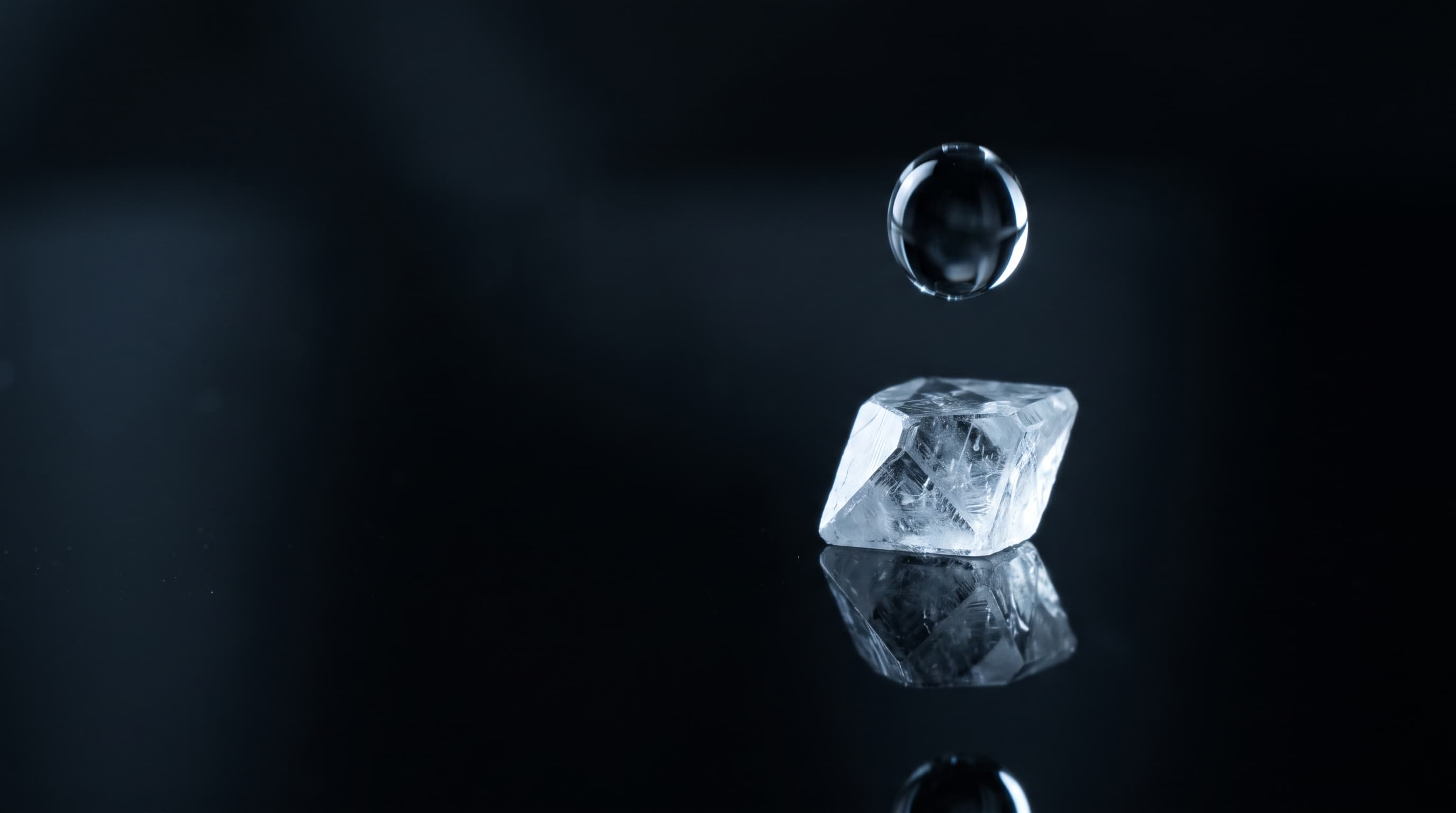
A clear drop of supersaturated sodium acetate solution falls onto a small seed crystal resting on a black glossy surface, and a white crystal tower grows upward from it while faint vapor rises.
Drag the bar or slow it down to watch the facets form.
01The science
What you're watching
The clear liquid in that drop is holding far more dissolved salt than water should be able to carry at room temperature. It sits balanced on a knife edge, and the seed crystal tips it over.
- Fig. 1
01Supersaturation
A liquid on a knife edge
Sodium acetate trihydrate melts at 58 °C, dissolving in the water held inside its own crystals. Cooled slowly and left alone, the liquid keeps every bit of it dissolved, far more than water can normally hold at room temperature.
- Fig. 2
02Nucleation
The seed sets the pattern
The seed crystal hands the dissolved salt a ready-made lattice. Sodium and acetate ions lock onto its faces in the same arrangement, each bringing three water molecules along, and every new layer becomes the template for the next.
- Fig. 3
03Release of heat
Why it's called hot ice
Building the lattice gives energy back: roughly 264 to 289 kilojoules for every kilogram that turns solid. The tower warms up and faint vapor lifts off it. It can climb toward 58 °C but never past it, because any hotter and the crystal would melt back into liquid.
02By the numbers
The chemistry in four numbers
Everything in the clip comes down to a few properties of one ordinary salt, the same one sealed inside reusable hand warmers.
- Melting point
- 58°C
- Where sodium acetate trihydrate melts into its own water of crystallization. The growing tower can warm toward it, never beyond.
- Heat released
- 264–289kJ/kg
- The latent heat of fusion: the energy every kilogram gives back as it crystallizes. It is the same effect that powers reusable hand warmers.
- Water in each unit
- 3H₂O
- Every unit of sodium acetate carries three water molecules into the crystal, written CH₃COONa·3H₂O. That built-in water is what it melts into.
- To start over
- 100°C
- A few minutes in boiling water dissolves the crystals again. Let the liquid cool undisturbed and it is supersaturated once more, ready for another tower.
03Try it yourself
Grow your own tower
Hot ice is a classic kitchen chemistry demonstration. All it takes is sodium acetate trihydrate, a splash of water, a very clean container and some patience.
- 01
Get the crystals
Buy food-grade sodium acetate trihydrate, or make your own: stir baking soda into white vinegar until the fizzing stops, gently boil the liquid down until a crystal skin forms on top, then let it cool and collect the crystals.
- 02
Dissolve them
Warm the crystals with a small splash of water, stirring until every grain has dissolved. Rinse any crystals off the sides with a little hot water, since one stray grain can set the whole batch off early.
- 03
Cool it undisturbed
Cover the container and let it cool to room temperature without moving it. If it stays perfectly clear, you have a supersaturated solution.
- 04
Seed it and pour
Set a few crystals on a dish and pour the liquid onto them in a slow, thin stream. The tower builds wherever the stream lands. Once it sets, touch it: it's warm.
Finished? Melt the tower down with a splash of water and you can grow it all over again.